
Decision Center
Shows only what needs the owner, at most five cards, ranked by urgency, risk and opportunity.
- Duplicate items are merged
- “Later” brings a card back the next morning
Business Brain
Agents watch the business all day. The owner decides.
For owners who run sales, stock, cash and customer care themselves and lose the day to checking and chasing. Data comes in from the store, the inbox and the ledger; agents turn it into proposals with evidence; the owner approves; only then does anything happen.

18
specialised agents
each one has run in production
17,486
logged agent runs
in about 7 weeks
178
proposals sent to the owner
35 approved, 2 dismissed, 126 expired, 15 waiting
0
actions taken without approval
anything touching customers, money or public posts waits for the owner
Counts from a live deployment, as of 11 Oct 2026. They are counts of activity, not a promise of results.
How it works
01
Website, inbox, bank, marketplaces
02
Six clusters: customers, marketing, orders, people, cash, products
03
18 specialists, each with one job
04
Agents propose. The owner decides.
05
Only after approval
What it does
Shows only what needs the owner, at most five cards, ranked by urgency, risk and opportunity.
Agents only propose. Nothing is sent, bought or posted on its own, and one switch stops the whole system.
A nightly CEO report, risk alerts, draft replies to customers, quote follow-ups, supplier price watching, partner quote analysis, product research, content drafts, self-checks and backups.
Give an order in plain words. The Brain hands it to the right agent, plans multi-step work, records the order, and reads attached PDFs, images, spreadsheets and Word files.
The owner writes rules and skills for each agent in everyday language. The base safety rules always win.
A data path lights up only when real data moves through it. Nothing is animated just to look busy.
Each indicator carries a target, a trend and a verdict: Good, Needs attention or Bad. With no target set, it says so.
Runs on the business's own machine, with role-based access, a log of every action and automatic backups.
The small panels above are simplified illustrations, not screenshots. The names and figures in them are sample data.
In production
Business Brain runs inside an owner-led consumer-goods import business, run by the founder of THIEN PHU CE. It has been in daily use for about seven weeks: 18 agents, 17,486 logged runs, and 178 proposals put in front of the owner.
The agents propose all day; the owner picks what is worth doing. So far the owner has approved 35 and turned down 2. The rest were left to lapse, and a lapsed proposal does nothing: no message is sent, nothing is bought, nothing is posted. We do not name the business or show its customers, partners, products or figures.
Status: one internal deployment, in daily use. No outside customers yet. Read the case study →
From the live system
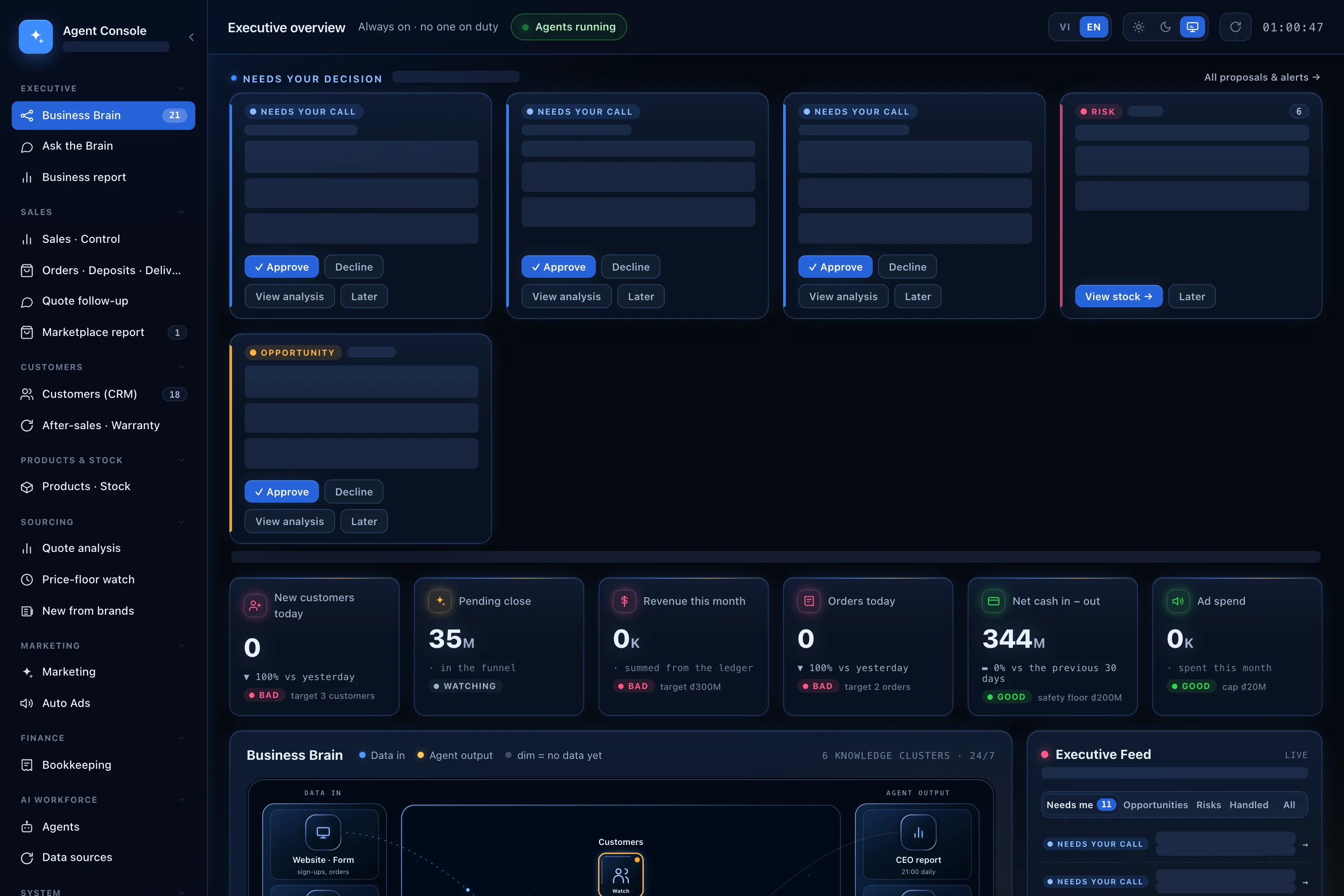
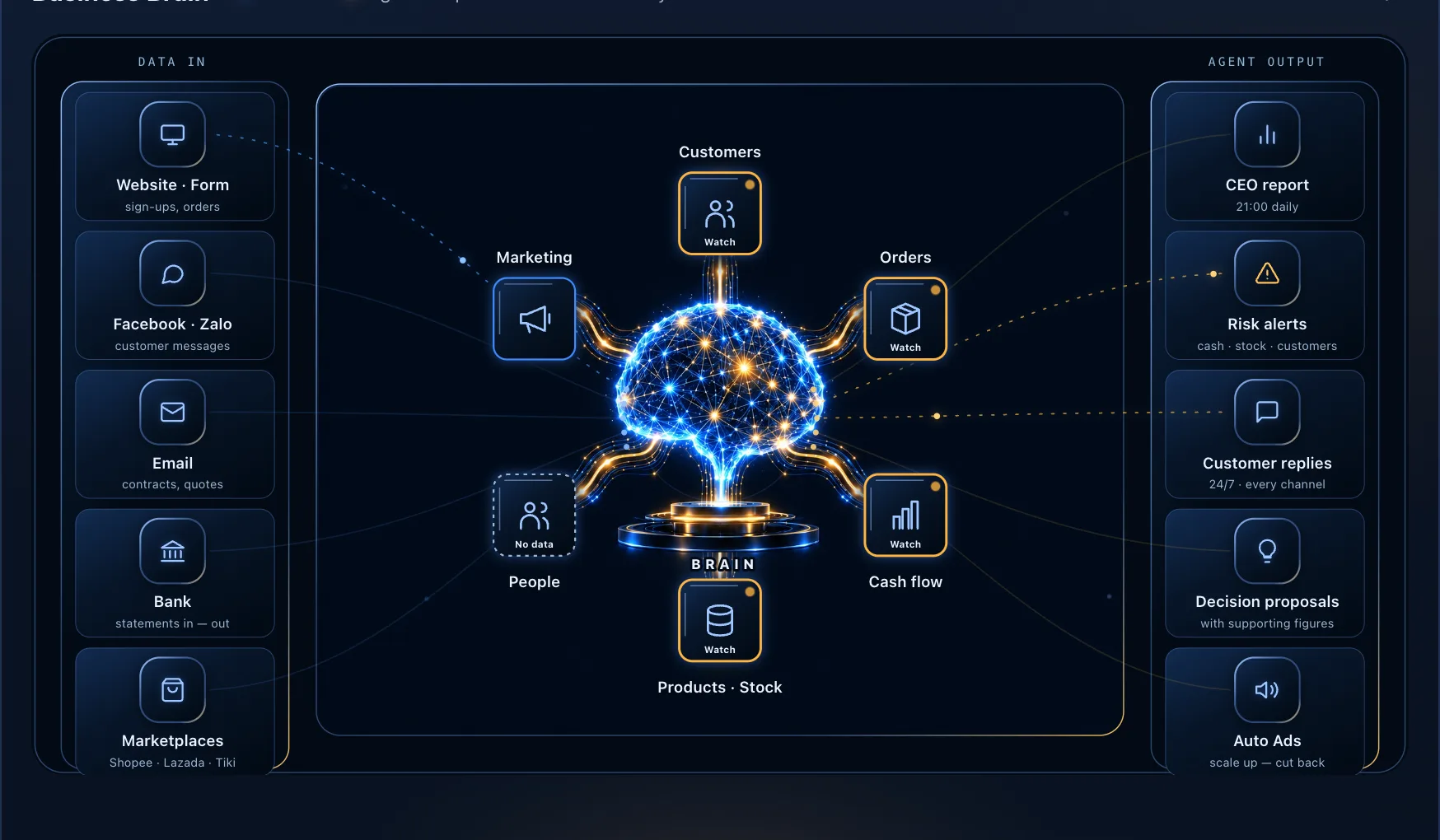
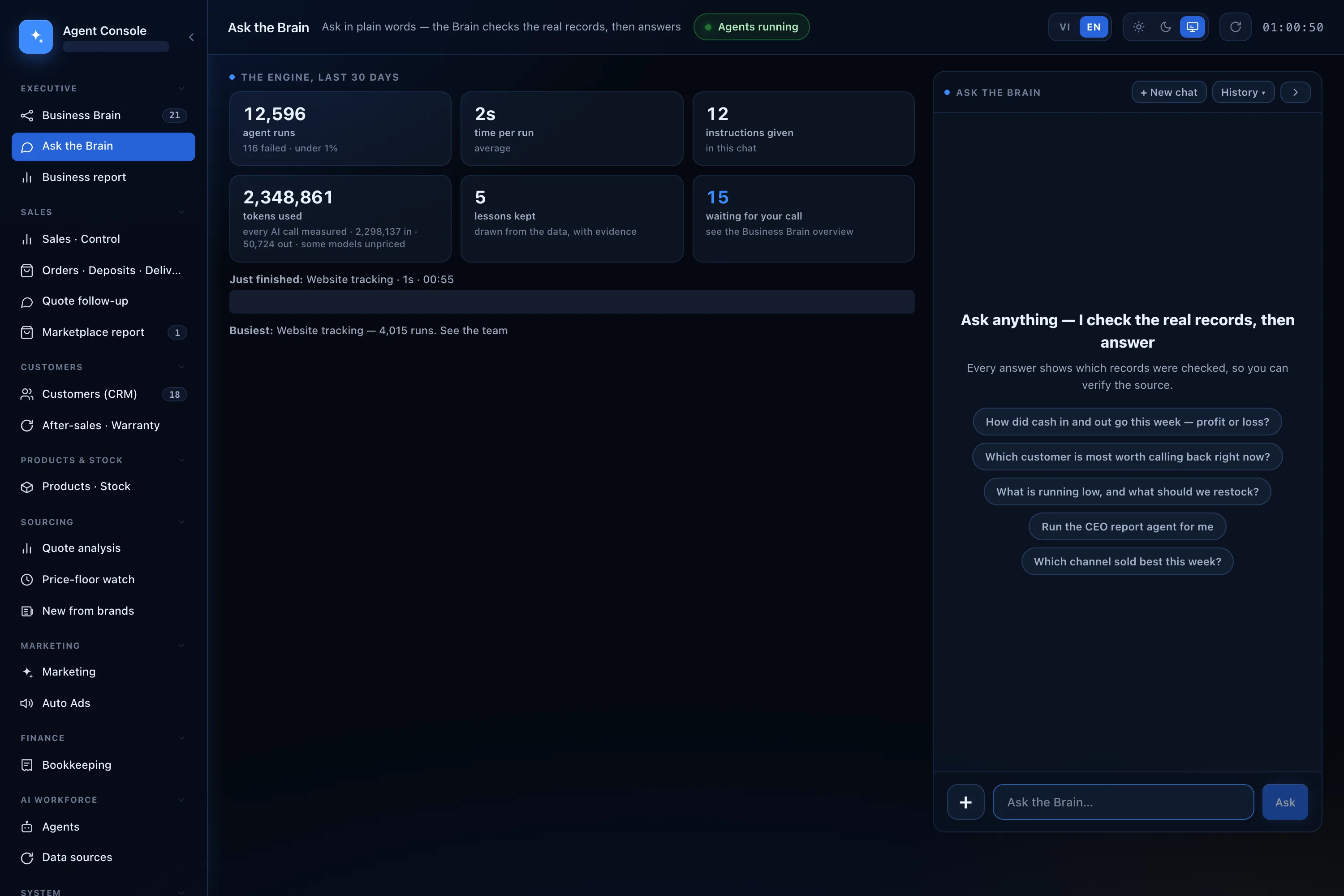
Live deployment, English interface (beta). KPI figures are sample data; customer names, product codes and prices are hidden.
Security & control
These controls are implemented in Business Brain. Access settings, backup schedules and integrations are configured for each deployment and checked during the pilot.
Anything that touches customers, money or public posts waits for the owner. Agents can only propose.
Four roles: owner, sales, accounting and view-only. Only the owner can approve or decline.
Accounts can require a second factor, with a security log of sign-ins and changes.
Each instruction goes into an order book and every agent run is logged with its input and result.
A single switch halts every customer follow-up sequence at once, and it can only be lifted on purpose.
The local deployment is configured to listen on the machine itself. Remote access requires an authenticated tunnel.
Data files use owner-only permissions to restrict access by other ordinary accounts on the machine.
A backup agent supports a configurable nightly schedule, defaulting to 03:30. Recovery depends on an available, valid backup.
Built with Claude Code and Codex
Claude Code is the main development tool, with Codex contributing interface improvements and independent reviews. The agents currently run through several models from the command line. Moving the agent runtime and the Ask the Brain chat to the Claude API is the next planned step.
Start with one workflow. Each deployment is set up for the business it serves, and nothing is promised before a pilot has run.